
Global direct spending on business events in 2025, across 1.65bn participants. Source 1, 2025 estimate.
KHANEVENTS.COM · proposed brand and domain opportunity
The decision layer
for everyday events.
KHAN EVENTS turns a loose event request into a budgeted, comparable, decision-ready brief — then connects the organiser to the suppliers and professionals who can deliver it. The working product is built; the commercial thesis is below, with sources.
At a glance
Four facts behind the thesis.
of surveyed in-house corporate event professionals report event expenses up at least 5% year on year. Source 3, 2026 survey.
The planning workspace is complete and usable today — brief, budget, quotes, run of show, exports. No account needed. Verified in this build.
The supplier marketplace is demonstrable end to end on clearly-labelled sample listings; verified supply is the next commercial gate. Status, September 2026.
Why this domain
KHANEVENTS.COM says the category out loud.
An assessment of the name and domain as a business asset. No ownership, trademark or exclusivity claim is made or implied.
KHANEVENTS.COM
- 11 letters, two plain words
- Category keyword in the name
- .com — the default extension users trust
- Room to extend: planning, suppliers, ticketing
- Memorability and spelling. Two common English words; easy to say, type and relay by phone.
- Category relevance. "Events" is the word customers search and use; the name names the market.
- Brandability. A name-plus-category pattern supports a house brand with room to extend into planning services, a supplier directory and ticketing.
- Social handles (checked 24 September 2026). X (@khanevents) and the LinkedIn company path returned "not found" (appearing unregistered); Instagram and Facebook returned ambiguous login-walled responses needing manual confirmation; YouTube redirected (inconclusive). Status-level checks only.
- Comparable sales. Method: NameBio's public sales database, filtered to the keyword "events" on .com; premium one-word category .com sales are widely reported in the six-to-seven-figure range. Specific comparable line items should be pulled and cited at launch before any figure is used. Comparables are context, not a valuation of this domain.
- Standing caveats. Public records show similarly-named businesses elsewhere; ownership and trademark clearance are owner inputs and remain unverified.
Sources: NameBio (method reference, checked 24 September 2026); handle checks performed checked 24 September 2026 by HTTP status; earlier domain-state research in the run record (S10–S11).
Market and timing
A very large market,
a very specific wedge.
The total market is the industry's own spending; the reachable launch segment — occasional organisers at small organisations in a to-be-confirmed region — is deliberately unquantified until demand research exists. No invented segment figures.
View the data and method
| Indicator | Figure | Source, date |
|---|---|---|
| Global direct business-events spending, 2025 | US$1.30 trillion | Events Industry Council Global Economic Significance Study (S01), accessed 2026-09-23 |
| Business-events participants, 2025 | 1.65 billion | Events Industry Council (S01), accessed 2026-09-23 |
| In-house corporate event professionals reporting expenses up 5%+ YoY | 79% of 111 surveyed | Skift Meetings, Corporate Meetings in 2026 (S03), accessed 2026-09-23 |
| Cost pressure among sourcing planners | Survey of 1,650+ planners | Cvent Planner Sourcing Report (S02), accessed 2026-09-23 |
Method: industry-scale indicators, not a TAM/SAM/SOM for KHAN EVENTS.
Why now
- Budget scrutiny is up while planning still runs on spreadsheets and inbox threads (Sources 2, 3).
- Professional tools target professionals — suites and venue marketplaces assume expertise or monetise suppliers; the occasional organiser is under-served (Sources 4–7).
- The wedge is cheap to serve. A private, no-account planning workspace costs little to run, making the demand test affordable before supply is recruited.
Why this app can win
Alternatives for the primary task — turning an event request into an approved plan: spreadsheets and email, venue marketplaces (Tagvenue, Peerspace), and professional suites (Cvent).
- Time to first useful result: a structured brief and live budget in minutes, no signup.
- Decision clarity: per-guest costs, tax caveats, inclusions and open questions side by side — not just prices.
- Trust and privacy: plans stay on the device by design; honest demo boundaries everywhere.
- Parity: responsive, free, mobile-first; a labelled sample marketplace shows the full journey before real supply lands.
The customer problem
"Organise the team event" is five jobs in one sentence.
Office managers, executive assistants and founders plan 20–150-person events a few times a year, without an events team. Today that means a spreadsheet for the budget, an inbox of quotes in different formats, a checklist in a notes app — and no single document a budget-holder can approve. Research describes the pressure: costs rising faster than budgets (Source 3), cost named as the decisive sourcing factor (Source 2). What it costs them: evenings of unstructured work, and decisions defended on gut feel.
The product, today
Built and demonstrable.
The planning workspace is the signature experience: from loose idea to a decision brief — budget with per-guest costs, comparable quotes, run of show, checklist — in minutes, entirely on the visitor's own device. The supplier marketplace and professional-services path complete the journey from plan to people.
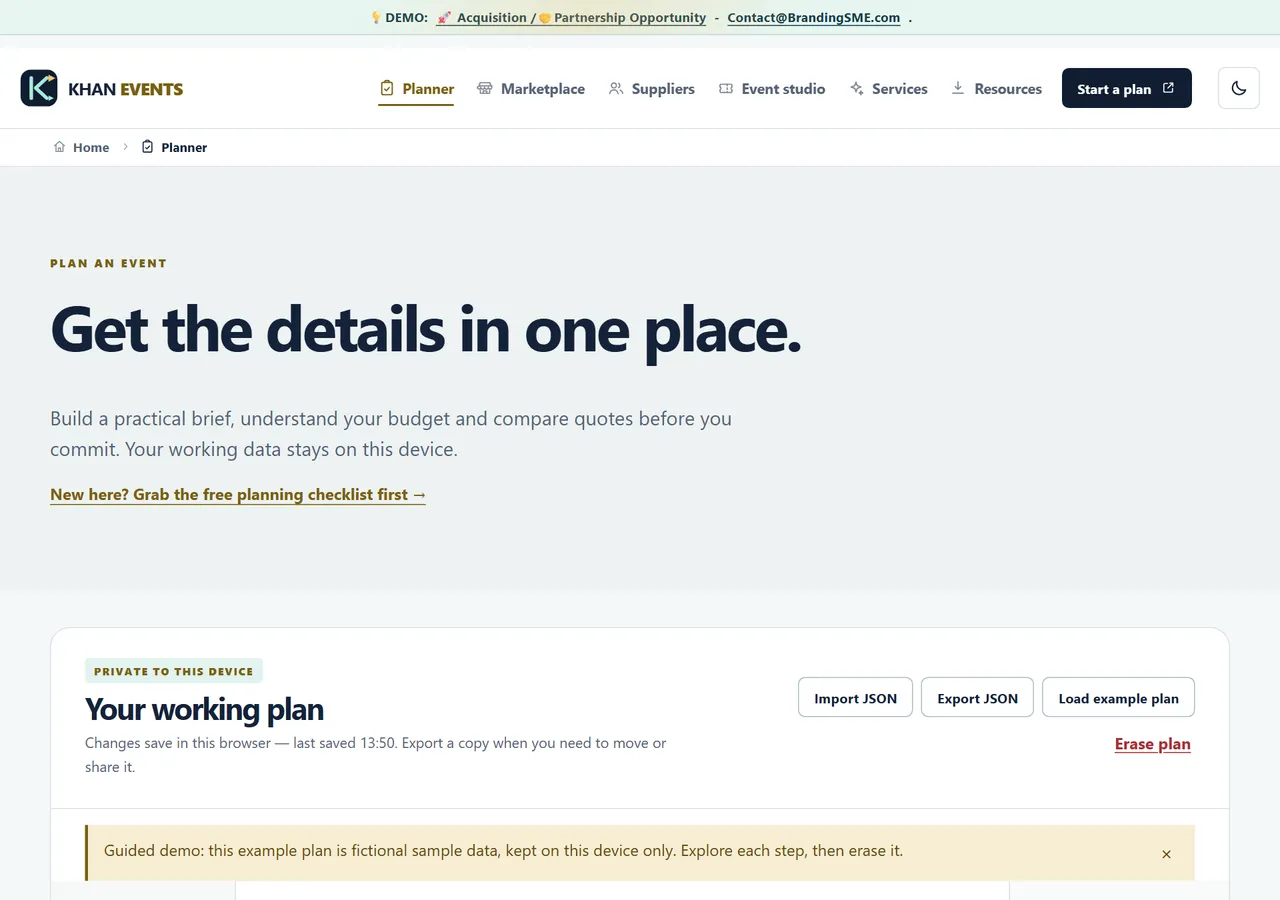
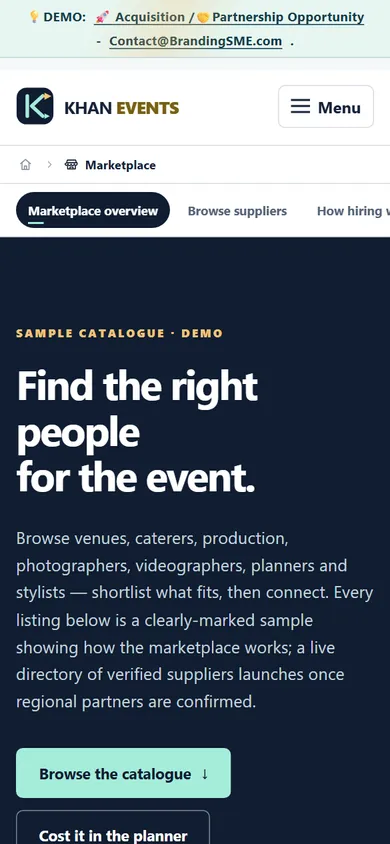
Operational today: planning workspace, templates, marketplace demonstration. Demonstrated with labelled sample data: marketplace listings and the example plan. Not yet operational: enquiry delivery, verified suppliers, booking and payment — each is a named owner input (see Risks).
Positioning
Between spreadsheets
and professional suites.
Built from the observed offers of the real alternatives (Sources 4–9); the axes are this assessment, not measured data.
Defensibility today is modest and stated as such: the brandable domain, an accumulating content and search position, and a verified-supply workflow that the sample catalogue has already rehearsed. Network effects arrive only with real two-sided volume.
Commercial model and route
Free tool. Scoped service.
Disclosed marketplace fees.
Everything monetary below is a proposal or projection, labelled as such and pending owner approval. No prices are published in the product.
Revenue lines
1. Scoped planning pilot — proposed fixed fee per brief/sourcing package. 2. Marketplace commission on completed bookings, disclosed per listing (industry pattern: venue-side commission, host-plus-guest fees — Sources 5, 7). 3. Verified/featured listings for suppliers, clearly labelled.
Go-to-market
Primary: direct partnership and referral outreach in the chosen region. Secondary: search content answering real organiser questions, feeding the free planner. A full 30/60/90 plan with stop rules is held in the run record.
Growth scenarios (projections)
At a proposed £250 average pilot fee and £140 direct cost per brief: conservative 1 brief/month → ≈£95 contribution; base 4 → ≈£425; optimistic 10 → ≈£1,085. Assumptions and sensitivity are documented in the run record. These are scenarios, not results or demand forecasts.
Roadmap
Each phase proves one thing.
Milestones from the 90-day plan; dates activate on owner approvals.
What each audience gains
Three ways in.
Investors
A working demonstration, a free demand engine that generates qualified planning intent, and a staged path to marketplace economics. Near-term milestones new capital would unlock: regional validation, the first supply cohort, and enquiry infrastructure. No terms, valuation or returns are offered or implied.
Strategic partners
Venue groups, caterers, AV and production companies, and planning professionals: distribution through the sample marketplace's future verified tier, co-marketed planning content, and a sourcing channel aimed at the customers who struggle most.
Acquirers
What exists today and could be included: the KHANEVENTS.COM domain (rights verification required), the complete codebase and design system, brand assets including the animated identity, planning templates and content, and the research base in this run record. Nothing else is claimed.
Risks, honestly
What could break this,
and how we would know.
- Demand is unproven. Validation: 10–15 target-organiser interviews and an unassisted prototype task; overturn if few complete a brief or would pay for nothing beyond the free tool.
- Cold-start marketplace. Mitigation: the tool is independently useful without supply; supply joins only after demand signals exist.
- Supply trust. No listing goes live without signed agreements and consent; samples never mix with verified listings.
- Disintermediation. Accepted at first: the wedge is decision support, not booking lock-in; fees attach only to real, disclosed value.
- Owner inputs outstanding. Region, brand/domain clearance, fulfilment capacity and contact infrastructure gate the commercial phase, not the demonstration.
Current status
- Working demonstration: complete and verified (unit, journey, visual and conformance checks)
- Customer interviews: not started — requires region and outreach authorisation
- Verified suppliers: none — requires agreements
- Enquiry delivery: prepared locally only — requires an authorised destination
- Revenue: none — proposals only
This candour is the point: the demo is demonstrable, and the gaps are named rather than hidden.
Enquiry
Talk to us about KHANEVENTS.COM.
Enquiries open your own email client with the subject pre-filled. Nothing is transmitted by this site itself, and no reply time is promised.
Invest
Conversations about the thesis, milestones and what new capital would unlock.
Investment enquiry — KHANEVENTS.COMPartner
Venues, caterers, production, photography, planning professionals: join the verified tier first.
Partnership enquiry — KHANEVENTS.COMAcquire
The domain, codebase, design system, brand assets, content and research — the items listed above.
Acquisition enquiry — KHANEVENTS.COMSources and method
- Events Industry Council — Global Economic Significance Study: 2025 direct business-events spending US$1.30tn; 1.65bn participants. eventscouncil.org (accessed 2026-09-23).
- Cvent — Planner Sourcing Report overview: survey of 1,650+ planners; cost-pressure themes. cvent.com (accessed 2026-09-23).
- Skift Meetings — Corporate Meetings in 2026: 111 in-house professionals; 79% report expenses up 5%+ YoY. meetings.skift.com (accessed 2026-09-23).
- Cvent Supplier Network & pricing — free sourcing tier; platform by quote. cvent.com (accessed 2026-09-23).
- Tagvenue — free to bookers; venue-side commission per confirmed booking. tagvenue.com (accessed 2026-09-23).
- HeadBox — corporate venue-finding and event management. headbox.com (accessed 2026-09-23).
- Peerspace — published host service fee (20%) and guest processing fee. support.peerspace.com (accessed 2026-09-23).
- Eventbrite — organiser pricing; free events free, paid-ticket transaction fees. eventbrite.com (accessed 2026-09-23).
- NameBio — public domain-sales database; comparable-sales method for the "events" keyword (method reference; checked 24 September 2026; specific line items to be cited at launch).
- Social handle checks — HTTP status checks of X, Instagram, Facebook, YouTube and LinkedIn paths for "khanevents" (checked 24 September 2026; status-level method, manually unconfirmed).
Method notes: figures are industry-scale indicators with geography and year stated; the reachable segment is deliberately unquantified. Growth scenarios are illustrative projections from documented assumptions, not results. This page is information, not an offer of securities; projections are not guarantees, and investment language is flagged for owner and professional review before publication.